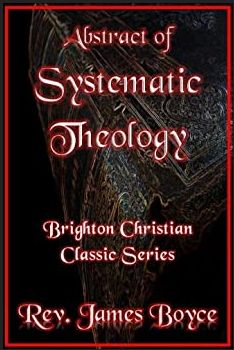
Boyce – Abstract of Systematic Theology

boyce-systematic-theology

Abstract of Systematic Theology By James Petigru Boyce

James Petigru Boyce

Author Biography: wikipedia.org:Boyce | tlogical.net:Boyce Read online: Founders.org

Abstract of Systematic Theology contains forty-two essays ranging in topic from the doctrines of God, the Trinity, and humanity, to creation, providence, and justification. Boyce also wrote extensively on the issues of election, atonement, and the immortality of the soul. Boyce’s theology was heavily influenced by Charles Hodge, and he used Hodge’s Systematic Theology text at the Southern Baptist Seminary.

The essays found in Abstract of Systematic Theology were originally intended to supplement the content of Boyce’s systematic theology classes at the seminary from 1859–1888. Boyce compiled and completed Abstract: “it is no mere logic chopping treatise but is vibrant with an experimental faith centered in Jesus Christ as Lord and Savior… .” Published in 1887.

Read more

Boettner Perseverance of the Saints

In Boettner Perseverance of the Saints7 chapter work on the perseverance of the Saints, Boettner (Reformed, Presbyterian) first states the doctrine, the shows us why it doesn’t depend on good works but God’s grace, he examines the Christian’s temporary slide back into sin, how an outward profession of righteousness is no guarantee of salvation, the arminian sense of insecurity, and warnings against apostasy.

Perseverance of the Saints

by Loraine Boettner

Summary

In this 7 chapter work on the perseverance of the Saints, Boettner (Reformed, Presbyterian) first states the doctrine, the shows us why it doesn’t depend on good works but God’s grace, he examines the Christian’s temporary slide back into sin, how an outward profession of righteousness is no guarantee of salvation, the arminian sense of insecurity, and warnings against apostasy.

Read more

Boettner, L. – Limited Atonement

Limited Atonement

by Loraine Boettner

Summary

In this 9 chapter work, Boettner (Reformed, Presbyterian) presents us with the doctrine of the limited atonement, i.e. Christ only died for the elect. He first states the doctrine, the examines the infinite value of Christ’s atonement, the limited purpose and application of the atonement, Christ’s work as a perfect fulfillment of the law, a ransom, the divine purpose, and the exclusion of the non-elect.

Read more