
Miller That Will Do is a single chapter from Miller’s book Young People’s Problem that treats a problem among people in not doing their best.
That Will Do!
J.R. Miller, 1898
(from his book, “Young People’s Problems”)
Someone says that the sentence, “That will do!” has done more harm than any other sentence in the English language! It indicates the acceptance of a standard below the highest — a person has done something which is not his best. He recognizes the fact; but he is too indolent to do it over again, or he is impatient to get the matter off his hands, and decides to let it go as it is. “That will do,” is a confession of unworthiness in what is done, and of indolence in the person who does it. He knows he could do better — but decides to let it pass.
Yet this miserable sentence is the ruling motto of many people’s lives. They never do the best they might do. Their whole life is slipshod. They began as children in school, doing barely well enough to pass. They never aimed to excel. They had no ambition to be first or to do perfect work. It was the same on the playground as in the schoolroom — they were satisfied to drag through the game, playing only passably well. They never put quite their whole soul into anything they did.
Thus habits of slothfulness were formed in their early years, and they have gone through life with the same unworthy spirit. They know they are not working up to their best — but it does not worry them. They have learned to say at every point, “That will do” — and this covers up the delinquencies, and apologizes for the failures.
All the standards of life are affected by it. Conduct is not what it should be. A man knows he is not doing what is really right, that his act would not bear the scrutiny of a rigid judgment; but he says indolently, “Oh, that will do” — and so passes over the matter without further compunction. Next time it is easier to fall below the mark; and so the trend is ever downward, until conscience ceases to sting and chide.
A man’s work or business also is affected by this spirit. He is content with small achievements and low attainments. He knows he is not accomplishing what he might accomplish — but it costs less to do things in this easy way, than to do them well — and he soon gets used to the low standard. So it comes about that the man who might have made a splendid mark for himself in his profession, in his business, or in his trade — never rises above a pitiable mediocrity. “That will do” has soothed his languishing enthusiasm into a sleep, out of which nothing ever can wholly awaken it.
Young people should train themselves from childhood never to be satisfied with anything but the very best they can do. A much better maxim to rule them would be, “The good — is the enemy of the best.” The good should not be enough; nothing should satisfy but the best. Children should begin in school by mastering every lesson, and keeping a high standard in all their studies. Then in their conduct and behavior, they should be most rigid with themselves, exacting . . .
the strictest truth in word and act,
the whitest purity in motive, thought, and feeling, and
the utmost sincerity and faithfulness in all their relations with others.
In whatever they do, they should be satisfied with nothing less than their very best. They should never allow themselves to say of any poor effort, whatever the haste or the weariness, “That will do.”
Nothing else is so enervating as the indolent, self-indulgent character. He who thus seeks to save himself — loses himself. Youth should scorn self-indulgence in every form. It should court hardship — rather than ease. What right have strong young men to demand luxury — soft beds, smooth roads, light burdens, short work hours? Rather it should be their goal to grapple with hardness and difficulty, and to be heroic in their struggles. Young men should be ashamed to do any duty indolently, or even to fall short of the best.
It is a great thing to have a lofty ideal and to live up to it. Michael Angelo said, “Nothing makes the soul so pure, so pious, as the endeavor to create something perfect; for God is perfect, and whoever strives for perfection, strives for something Godlike.” The blessing is in the striving. “Not failure — but low aim, is crime.”
Though we fail to reach our ideal, the effort to reach it does us good. First, it proves our faithfulness. How can we ever look God in the face, if we have not earnestly tried to do our best? But when we have struggled with all our might toward the attainment of the noble ideal which haunts us, though we have come short of it — we shall not be ashamed to stand before God at last, conscious that we have done our best.
Striving always after the perfect ideal, also lifts us step by step toward the ever-unattained excellence. We grow better, through every effort we make to be better. Every time we try to do any most common work perfectly — we are doing also another work of far greater importance on our own character. The carpenter is a better man, for having wrought a good piece of carpentering. The housekeeper is a better woman, for having made her home beautiful, and filled it with comfort and the sweetness of love. Doing the most common tasks well, makes the life itself nobler and more Christlike.
On the other hand, he who does anything indolently, in slovenly fashion, less skillfully than he could have done it — has not only left a piece of work in the world which will shame him some day — but has also done harm to his own soul and character.
We do not think enough of this effect on our character, of what we do in our ordinary tasks. We say it makes no difference if we skimp our work, when there is nothing important in it. You write a postal-card carelessly. The carpenter does not take pains with the piece of carpentering he is doing. The pupil does not get the lesson thoroughly. The housekeeper does not sweep the dark corners of her rooms. The author writes his book hurriedly, not doing his best. None of these people thinks of any other evil result, but that which is left in the work itself; that they confess is not what it might have been. But in each case, a far more serious evil result was left in the life of him who did his task in a negligent way. We are working all the while in two spheres — on matter, where men see the kind of work we do — and on our own inner life and character, where only God’s eye can see the marks we make.
We are not accustomed to consider this close identifying of our common task-work, in the world with our own moral and spiritual up-building. Carelessness in our daily duties, hinders our growth and sanctification. Doing the best we can in our secular occupations, makes us holier, and helps to fashion the image of Christ in our heart.
Thus it is much more important than we are apt to think, that we strive always to do perfect work, even in the lowliest and the commonest things we undertake. What we do outside for men’s eyes — we do also within for God’s eyes. “Whatever you do, work at it with all your heart, as working for the Lord, not for men” Colossians 3:23
Slovenly work in school, or in business, or on a building, or on a farm, or in the home — is also slovenly work on one’s own character!
Many catastrophes come in later years from doing imperfect or careless work in youth. When digging for the foundation of a great building, the workmen came upon a piece of old wall. “That will do,” they said; and they left it in the new wall, building around it. The great structure went up, and was filled with business. One day there was a crash. The fragment of old wall had given way, and the whole building fell in ruin!
Continually, young people are leaving in the foundation walls of their character — a fault, a wrong habit, a weakness, a flaw. It would be hard to dig it out. It is easier just to build over and around it, and so they let it stay. “That will do,” they say apologetically. Then years afterward, in some great stress or strain, the character fails and falls into ruin; it is seen then that that careless piece of foundation-building was the cause of it all.
No more serious problem arises in a young person’s life, than the temptation, ever-recurring — to do things negligently, to pass slipshod or slovenly work. Nothing but the best we can do in the circumstances, should ever be allowed to leave our hands. Never should any young person permit his work, his words, his life, any of his habits — to be ruled by a motto so unworthy, so debasing in its influence, as, “That will do!”
“Do your best to present yourself to God as one approved, a workman who does not need to be ashamed” 2Ti_2:15
“So that you may be able to discern what is best and may be pure and blameless until the day of Christ” Php_1:10
miller-that-will-do.topx (72 downloads )
Biography of JR Miller
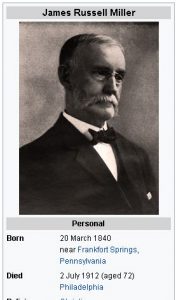
James Russell Miller (20 March 1840 – 2 July 1912) was a popular Christian author, Editorial Superintendent of the Presbyterian Board of Publication, and pastor of several churches in Pennsylvania and Illinois. In 1857, James entered Beaver Academy and in 1862 he progressed to Westminster College, Pennsylvania, which he graduated in June 1862. Then in the autumn of that year he entered the theological seminary of the United Presbyterian Church at Allegheny, Pennsylvania.
The Christian Commission
The Christian Commission was created in response to the disastrous First Battle of Bull Run. On 14 November 1861, the National Committee of the Young Men's Christian Association (YMCA) called a convention which met in New York City. The work of the United States Christian Commission was outlined and the organization completed the next day.
In March 1863, Miller promised to serve for six weeks as a delegate of the United States Christian Commission, but at the end of this time he was persuaded to become an Assistant Field Agent and later he was promoted to General Field Agent. He left the Commission on 15 July 1865.
Further Studies and the Pastorate
Miller resumed his interrupted studies at the Allegheny Theological Seminary in the fall of 1865 and completed them in the spring of 1867. That summer he accepted a call from the First United Presbyterian Church of New Wilmington, Pennsylvania. He was ordained and installed on 11 September 1867. Miller pastored various Presbyterian churches until his death. See Wikipedia.org for a Complete Biography of John Miller
Books by John Miller
During the time that John Miller was on the Presbyterian Board, he added several dozen periodicals to their offerings. Miller's lasting fame is through his books. Many are still in publication.
- Family Prayers for Thirteen Weeks
- Bible Readings from the Life of Christ
- Christlike Living in a Sinful World
- Living without Worry
- Week Day Religion, 1880
- Home Making, 1882 (currently published by The Vision Forum as The Family) theWord
- In His Steps: For Those Beginning the Christian Life, 1885 theWord
- The Wedded Life, 1886
- Silent Times, 1886
- Come Ye Apart, 1887
- The Marriage Altar, 1888
- Practical Religion, 1888
- Bits of Pasture, 1890
- Making the Most of Life, 1891
- The Everyday of Life, 1892
- Girls: Faults and Ideals, 1892
- Young Men: Faults and Ideals, 1893
- Glimpses Through Life's Windows, 1893
- The Building of Character, 1894
- Secrets of Happy Home Life, 1894
- Life’s Byways and Waysides, 1895
- For a Busy Day, 1895
- Year Book, 1895
- Family Prayers, 1895
- The Hidden Life, 1895
- The Blessing of Cheerfulness, 1896
- Things to Live For, 1896
- Story of A Busy Life, 1896
- A Gentle Heart, 1896
- Personal Friendships of Jesus, 1897
- By the Still Waters, 1897
- The Secret of Gladness, 1898
- The Joy of Service, 1898
- The Master’s Blessed, 1898
- That will Do 1898
- Young People’s Problems, 1898 theWord
- Unto the Hill, 1899
- Strength and Beauty, 1899
- The Golden Gate of Prayer, 1900
- Loving My Neighbour, 1900
- The Ministry of Comfort, 1901
- Summer Gathering, 1901
- How? When? Where?, 1901
- The Upper Currents, 1902
- Today and Tomorrow, 1902
- In Perfect Peace, 1902
- The Lesson of Love, 1903
- The Face of the Master, 1903
- Our New Eden, 1904
- Finding the Way, 1904
- The Inner Life, 1904
- Manual for Communicant Classes, 1905
- The Beauty of Kindness, 1905
- When the Song Begins, 1905
- The Best Things, 1907 theWord
- Glimpses of the Heavenly Life, 1907
- Morning Thoughts for Every Day in The Year, 1907
- Evening Thoughts, 1908
- The Gate Beautiful, 1909
- The Master's Friendships, 1909
- The Beauty of Every Day, 1910
- The Beauty of Self Control, 1911
- Learning to Love, 1911
- The Book of Comfort, 1912
- The Joy of The Lord, 1912
- Devotional Hours with the Bible (eight volumes), 1909-1913